
Soil Health is the Foundation of Food Security and Ecological Resilience
Soil health is fundamental to food security, water management, ecological stability, and the long-term prosperity of human communities. Yet people often regard soil simply as the material in which plants grow or the surface on which they conduct agriculture, practice forestry, and build communities.
In reality, healthy soil is a complex, living system that performs functions essential to the natural environment and the continued well-being of society.
Soil supports the production of food, the growth of forests, the regulation of water, and the biological processes that sustain entire ecosystems. Its condition influences agricultural productivity, watershed stability, biodiversity, and the capacity of landscapes to recover from environmental pressures.
These functions make soil much more than an agricultural resource. It is a form of natural infrastructure: an essential foundation upon which many other environmental, economic, and social systems depend.
The Food and Agriculture Organization’s overview of soils describes soil as essential not only to food production but also to water regulation, biodiversity conservation, climate regulation, and other ecosystem services. These functions demonstrate why agriculture, environmental restoration, and human development must account for soil.
FAO
Understanding this relationship changes how we approach land management and development. We must recognize and protect, maintain, and regenerate soil’s productive capacity rather than treat soil as an expendable input.
Soil Health: Understanding a Living System
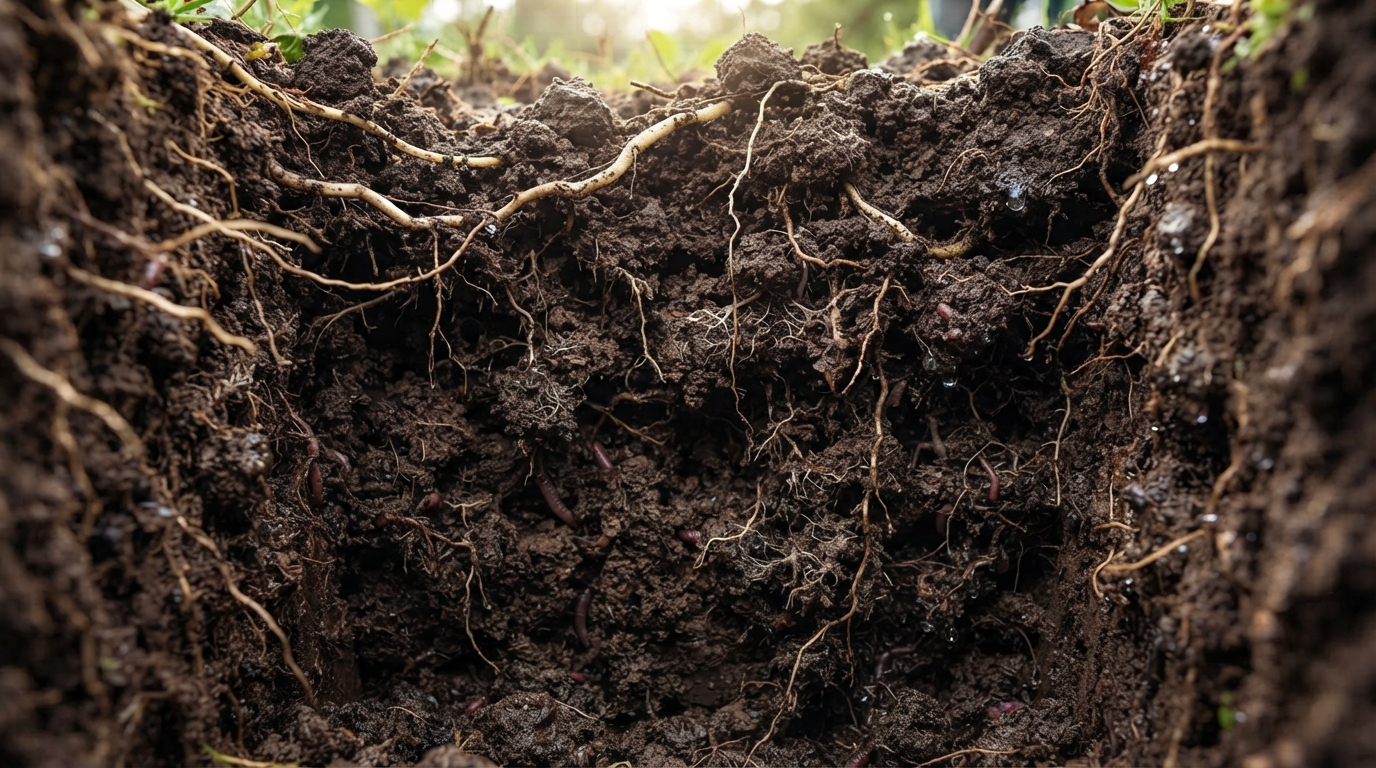
Soil is composed of mineral particles, organic matter, water, air, and an extraordinary diversity of living organisms. These components interact continuously, creating a dynamic environment that supports plant growth and numerous ecological processes.
Bacteria, fungi, earthworms, insects, and other organisms contribute to the decomposition of organic materials, the cycling of nutrients, the development of soil structure, and the movement of water and air through the ground. Plant roots interact with these organisms, exchanging nutrients and contributing organic compounds that support biological activity.
Mycorrhizal fungi, for example, form associations with the roots of many plants. These relationships can help plants access water and nutrients beyond the immediate reach of their roots. Other microorganisms participate in the transformation of organic materials and the cycling of essential nutrients.
The result is an interconnected biological system in which the physical, chemical, and biological characteristics of soil influence one another.
Soil health depends on more than the presence or growth of plants. A field may produce a harvest even as it loses organic matter, develops compaction, suffers erosion, or experiences declining biological activity. Visible productivity alone does not prove that the soil retains its long-term productive capacity.
A more complete assessment considers whether the soil retains its capacity to support vegetation, cycle nutrients, regulate water, and sustain biological activity over time. The United States Department of Agriculture’s Natural Resources Conservation Service soil health guidance describes soil health as the continued capacity of soil to function as a living ecosystem that sustains plants, animals, and people.
Natural Resources Conservation Service+1
Soil Health and the Water Cycle
One of the most important functions of healthy soil is its relationship with water.
Soil structure influences how rainfall enters the ground, how water moves through different layers, and how much moisture remains available to plants. Organic matter, stable soil aggregates, root systems, and biological activity can contribute to improved infiltration and water retention.
When rain falls on healthy, well-structured soil, a greater proportion may infiltrate rather than immediately flow across the surface. Vegetation and organic material also help protect the soil from the direct impact of rainfall, reducing the potential for surface sealing, runoff, and erosion.
These functions are particularly important in areas exposed to irregular rainfall, drought, intense storms, or seasonal flooding.
Degraded or compacted soil may have reduced capacity to absorb water. When vegetation is removed and the soil surface is left exposed, rainfall can carry away valuable topsoil and organic matter. The resulting erosion further reduces the land’s ability to support vegetation and maintain its productive capacity.
Healthy soil does not create rainfall, guarantee groundwater recharge, or eliminate flooding. Those outcomes depend on many additional factors, including geology, topography, vegetation, rainfall patterns, and watershed conditions. Nevertheless, soil condition is an important component of how landscapes receive, store, filter, and redistribute water.
The FAO’s discussion of soil and water regulation explains the importance of soil to water availability and the broader hydrological cycle. Protecting soil is therefore one part of protecting the watersheds upon which agriculture and communities depend.
FAO+1
Soil Health and Food Security
Food security depends upon more than the availability of agricultural land. It also depends upon whether that land can continue producing food reliably and sustainably.
Healthy soil provides the physical environment in which crops establish roots, obtain water, and access nutrients. Its structure influences aeration, drainage, and root development, while its biological activity contributes to nutrient cycling and the decomposition of organic materials.
When soil organic matter and biological activity decline, the consequences may extend well beyond an individual growing season. Reduced water retention, erosion, compaction, and nutrient depletion can increase production challenges and make agricultural systems more vulnerable to environmental pressures.
Maintaining soil health is therefore a fundamental part of maintaining agricultural capacity.
This consideration applies to conventional agriculture, small-scale food production, agroforestry, and food forests. Each depends upon the condition of the underlying soil, although the appropriate management practices may differ according to climate, soil type, vegetation, and intended use.
A productive landscape should not be evaluated only by the quantity of food it produces today. Its continued ability to produce food without progressively undermining its own ecological foundation is equally important.
This is one reason OPISAC’s approach to integrated reforestation and agroforestry development considers food production and ecological restoration together. Food forests, agroforestry systems, and other forms of integrated land use can connect the productive needs of communities with the protection and regeneration of the land on which those communities depend.
Food security and soil conservation are consequently interconnected concerns.
Soil Degradation: The Loss of Natural Infrastructure
Soil degradation occurs through a variety of physical, chemical, and biological processes. Some develop gradually, while others can produce significant damage in a relatively short period.
Erosion removes fertile surface layers through wind and water. Compaction reduces pore space and can restrict the movement of water, air, and roots. The loss of organic matter can weaken soil structure and reduce the resources available to soil organisms.
Other forms of degradation include salinization, contamination, nutrient depletion, and the disruption of biological processes through unsuitable land management.
Deforestation and the removal of protective vegetation can expose soil to erosion and alter the movement of water through a landscape. Poorly managed cultivation, excessive disturbance, and inappropriate irrigation practices can also contribute to declining soil function.
The consequences are not confined to the agricultural property where degradation occurs. Sediment can enter waterways, nutrient losses can affect downstream environments, and reduced vegetation can influence habitat quality and watershed stability.
In this way, soil degradation can create costs that extend across entire communities and landscapes.
The FAO identifies erosion, nutrient imbalances, salinization, acidification, and contamination among the significant threats to soils in the Asia-Pacific region. Its discussion of soil management in Asia and the Pacific is particularly relevant to the varied conditions found throughout the region.
FAOHome
The loss of soil function is therefore not simply a problem for farmers. It is a concern for water security, environmental conservation, infrastructure planning, and long-term economic resilience.
Soil Regeneration: Restoring Productive Capacity
Protecting soil health requires more than preventing visible erosion. It involves maintaining or rebuilding the biological, physical, and chemical conditions that allow soil to function effectively.
The appropriate approach depends upon the existing soil, climate, land use, and degree of degradation. There is no single treatment or management practice suitable for every location.
Nevertheless, several widely recognized principles can guide soil conservation and regeneration:
- Maintaining soil cover: Vegetation, crop residues, and suitable organic mulches help protect the surface from erosion and reduce exposure to extreme temperatures.
- Maintaining living roots: Growing plants provide organic inputs and support the organisms living within the soil.
- Increasing biological diversity: Appropriate combinations of vegetation and cropping systems can support a wider range of soil organisms and ecological relationships.
- Reducing unnecessary disturbance: Limiting unsuitable or excessive soil disturbance can help preserve soil structure and biological activity.
- Restoring organic matter: Compost, plant residues, and other suitable organic materials can contribute to soil structure, nutrient cycling, and water retention.
- Managing water appropriately: Practices suited to local conditions can help reduce runoff, erosion, and water loss.
These principles correspond closely with the four soil health principles outlined by the USDA Natural Resources Conservation Service: minimizing disturbance, maximizing soil cover, maximizing biodiversity, and maximizing continuous living roots. Its soil health principles and practices guide provides practical explanations of these approaches.
Permaculture and agroforestry provide useful frameworks for considering these relationships across productive landscapes. Rather than treating soil, vegetation, water, and food production as separate concerns, they encourage the design of systems in which these elements can support one another.
OPISAC’s Permaculture Centers are intended to bring several of these functions together. Their planned roles include composting, soil remediation, seed and plant propagation, agricultural support, and the production of nutrient-rich growing materials for food cultivation and landscape rehabilitation.
The centers’ approach to soil improvement also recognizes that degraded land may require more than the addition of ordinary compost. Depending on the local conditions and intended use, soil rehabilitation can involve combinations of organic matter, biologically active compost, suitable amendments, vegetation, and appropriate water management.
The objective is not simply to produce a material that looks like topsoil. Natural topsoil develops through complex biological, geological, and ecological processes over time. The more practical objective is to produce high-quality, biologically active soil amendments and growing media, while improving existing soils so that they can increasingly support productive vegetation and ecological recovery.
The Permaculture Center therefore serves a broader purpose than food production. It functions as a productive and educational facility, supporting soil regeneration, plant propagation, food production, and the practical skills communities need to establish and maintain these systems.
Soil Health and Ecological Resilience
Soil is also the foundation of terrestrial ecosystems.
Forests, grasslands, wetlands, agricultural landscapes, and other terrestrial environments rely on soil processes to sustain vegetation and support biological communities. Soil influences which plants can establish themselves, how landscapes retain water, how nutrients circulate, and which organisms can survive in a particular environment.
Soil degradation can disrupt the entire ecological system. Reduced vegetation exposes more soil to erosion, while declining organic matter and biological diversity weaken the natural processes that support regeneration.
Conversely, improving soil conditions can help establish the foundation for vegetation recovery, habitat restoration, and more resilient landscapes.
This relationship is especially important in reforestation. Planting trees is not, by itself, sufficient to restore a functioning forest ecosystem. Successful restoration also depends upon soil condition, water availability, suitable species selection, biodiversity, and the relationships between vegetation and the surrounding landscape.
The same principle applies to ecological corridors. Connecting fragmented habitats requires more than establishing lines of trees or vegetation between isolated areas. The land must be capable of supporting the ecological functions and biological communities that make connectivity meaningful.
OPISAC’s reforestation programs and its broader approach to integrated reforestation and agroforestry recognize the importance of combining vegetation restoration with food production, local participation, and long-term land stewardship.
Soil health is therefore one of the underlying considerations in both ecosystem restoration and landscape connectivity.
Looking Beyond the Individual Field
We must consider soil beyond the boundaries of an individual farm, garden, or restoration site. Its condition affects and responds to the wider landscape through watersheds, vegetation patterns, drainage systems, habitats, and human land use.
This is where integrated approaches to land management become particularly important.
Permaculture offers a framework for designing productive relationships among soil, water, vegetation, animals, and human activities. Agroforestry combines trees and other vegetation with agricultural production in ways suited to particular ecological and economic conditions.
The broader RUrban concept also provides a useful perspective. Rural and urban communities are not independent systems. They are connected through food production, markets, transportation, water, employment, infrastructure, and the movement of resources.
The condition of rural soils can influence the food security, economic stability, and environmental quality of communities far beyond the boundaries of the land being cultivated. Likewise, responsible urban development can contribute to more effective resource use, reduced pressure on surrounding landscapes, and stronger connections between producers and the communities they serve.
These relationships reinforce the importance of considering soil within a larger system of environmental and human development.
For OPISAC, this means that soil conservation and regeneration are not isolated environmental activities. They are relevant to the planning of agricultural projects, reforestation initiatives, food production systems, Permaculture Centers, and Rural Development Centers. Each can contribute to a larger network of productive and restorative activities when designed around local ecological conditions and community needs.
The FAO’s framework for sustainable land management similarly emphasizes the integration of soil, water, plants, and other land resources to maintain long-term productive potential while preserving environmental functions.
Sustainable Development Begins Beneath Our Feet
Soil is among the most fundamental forms of natural infrastructure. It supports food production, regulates water, sustains biodiversity, and provides the foundation for terrestrial ecosystems.
Its value cannot be measured solely by the amount of food or timber that can be produced from a particular area. Soil also performs essential ecological functions that contribute to the stability and resilience of entire landscapes.
When soil is depleted or degraded, the consequences extend into agriculture, water systems, biodiversity, and the economic well-being of communities. When soil is protected and regenerated, it can help restore the productive and ecological capacity upon which those systems depend.
Recognizing soil as infrastructure changes the way development is approached. It encourages long-term thinking, responsible land management, and a more integrated understanding of the relationships between human activity and the natural environment.
Sustainable development does not begin with buildings, roads, or agricultural production alone. It begins with the living systems that make those activities possible.
Sustainable development begins beneath our feet starting with soil health.
Leave a Reply