
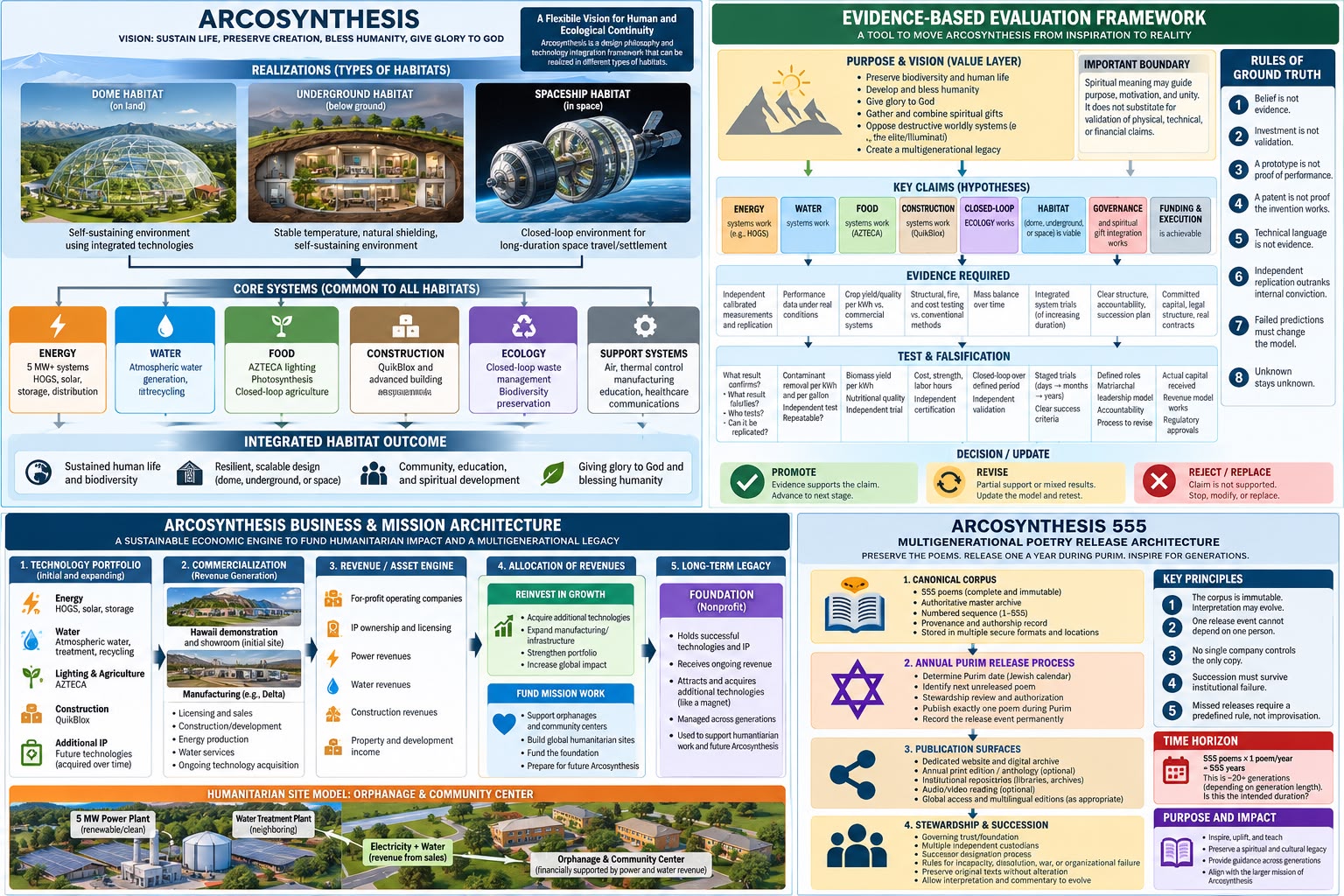
Integrating Nature, Science, and Technology for Sustainable Human Growth and Development
A Vision of Integration
Humanity has made extraordinary advances in science, engineering, agriculture, energy production, construction, and technology. Yet many of the systems upon which modern society depends continue to operate independently of one another, often creating problems that could be reduced through greater coordination and integration.
Energy production affects water availability. Agricultural practices affect soil, biodiversity, and ecosystems. Construction consumes materials and energy while determining the environments in which people live. Economic systems influence how resources are distributed, how communities develop, and whether environmental restoration receives the attention it requires.
These challenges are interconnected, and addressing them individually is not always sufficient.
What if we approached human development differently?
What if the systems that sustain human life were designed to complement one another, drawing upon the principles of nature, the discoveries of science, the capabilities of technology, and the collective knowledge of humanity?
This is the central idea behind Arcosynthesis: bringing diverse elements together into an integrated, adaptive, complementary whole, with the purpose of supporting life, preserving natural systems, and advancing sustainable human growth and development.
Arcosynthesis is not simply a particular technology, agricultural method, or economic model. It is an overarching vision of integration that seeks to understand how different systems can work together, rather than operate as isolated components.
Its underlying aspiration is to develop approaches to human habitation, resource utilization, environmental stewardship, and community development that recognize the interdependence of all living systems.
Learning from Nature: The Principles of Integration
Nature provides some of the most compelling examples of integrated systems.
Consider photosynthesis.
Through this fundamental biological process, plants use sunlight, water, and carbon dioxide to produce the chemical energy necessary for growth, releasing oxygen in the process. What might initially appear to be separate environmental elements becomes part of an interconnected biological system that supports life.
Photosynthesis is particularly meaningful to the philosophy of Arcosynthesis because it demonstrates how different elements can combine to produce something greater than their individual contributions.
Sunlight alone does not produce a growing plant. Water alone does not sustain an ecosystem. Air, nutrients, soil, light, and biological processes all contribute to the conditions necessary for life.
The significance extends beyond plants. Ecosystems depend upon relationships among organisms, water cycles, atmospheric processes, soil formation, mineral availability, and the movement of energy through living environments.
These relationships offer valuable lessons for human development.
Rather than treating agriculture, water management, energy production, construction, and environmental conservation as unrelated activities, we can explore ways to coordinate them so that the output of one system may contribute to the requirements of another.
For example, appropriately designed agricultural systems can integrate water conservation, nutrient recovery, renewable energy, and biological production. Buildings can incorporate passive environmental design, efficient energy systems, and water-management features. Community developments can incorporate food production, green spaces, biodiversity, and resource recovery.
The objective is not to imitate every natural process mechanically, but to learn from the principles of interdependence, balance, adaptation, regeneration, and efficient resource utilization that are evident throughout nature.
From Individual Technologies to Integrated Systems
A central principle of Arcosynthesis is that no single invention or technological development represents the entire vision.
The greater opportunity lies in how different technologies and systems may complement one another.
The Arcosynthesis research and development vision encompasses several interconnected areas:
Energy Systems
Energy is fundamental to modern human activity. Solar, hydroelectric, and other renewable energy technologies, together with energy efficiency, storage, distribution, and recovery systems, offer opportunities to improve the way communities produce and utilize power.
The objective is to explore energy systems that can support buildings, agricultural operations, water infrastructure, manufacturing, and other essential activities while reducing unnecessary resource consumption.
Water Systems
Water is essential to every aspect of human development. Its availability, quality, conservation, distribution, and reuse directly affect agriculture, public health, ecosystems, and economic activity.
Integrated water systems can incorporate collection, treatment, filtration, storage, distribution, and appropriate recycling technologies. Their design must account for local hydrological conditions, water quality, environmental requirements, and the needs of surrounding communities.
Food and Agricultural Systems
Food production is among humanity’s most fundamental activities, yet conventional agricultural practices can place considerable demands upon land, water, energy, and other resources.
Arcosynthesis explores complementary approaches that may include permaculture, aquaponics, hydroponics, algae cultivation, controlled-environment agriculture, food forests, and other sustainable growing methods.
These approaches can provide opportunities to improve production efficiency, diversify food sources, restore degraded land, and develop more resilient local food systems.
Construction and Habitat Systems
The environments in which people live have a profound influence on health, economic opportunity, resource consumption, and quality of life.
Construction technologies, building materials, architectural design, and environmental systems can be coordinated to create structures that are durable, efficient, adaptable, and appropriate to their surroundings.
This includes exploring alternative construction methods, energy-efficient buildings, integrated growing environments, and specialized habitat concepts.
Ecological Systems
Human development cannot be separated from the natural environments upon which it depends.
Biodiversity, soil health, forests, wetlands, watersheds, and other ecological systems provide essential functions that support life and economic activity.
Environmental restoration, conservation, reforestation, habitat preservation, and regenerative land management therefore form an important part of the Arcosynthesis vision.
The objective is to recognize ecological systems not merely as resources to be consumed, but as living systems whose continued health is essential to the long-term well-being of humanity.
Support and Infrastructure Systems
The integration of energy, water, food, construction, and ecological systems requires supporting infrastructure, management, monitoring, communications, education, and other capabilities.
These supporting systems help connect individual technologies into functioning environments.
The ultimate objective is to develop an integrated approach in which the various components can be coordinated according to the needs and conditions of each location.
Different Environments, Shared Principles
The principles of Arcosynthesis are not limited to a particular architectural form or geographical setting.
Human habitation can take many forms, depending upon environmental conditions, available resources, technological capabilities, and the needs of the people who occupy those environments.
Three broad habitat concepts illustrate the range of possibilities.
Above-Ground Environments
Conventional and alternative buildings, integrated greenhouses, glass domes, and planned communities can incorporate energy, water, food production, and ecological systems into their design.
Underground Environments
Earth-sheltered structures and underground habitat concepts offer opportunities to investigate thermal stability, land utilization, environmental protection, and specialized living environments. Their practical application depends upon engineering, ventilation, structural safety, geological conditions, and other requirements.
Space Environments
The development of human habitation beyond Earth presents additional challenges involving energy, water recovery, food production, atmospheric management, radiation protection, and closed-loop life-support systems. These concepts represent long-term research and development possibilities rather than established Arcosynthesis capabilities.
Although these environments differ considerably, the underlying requirements remain remarkably similar.
People need breathable air, clean water, food, energy, shelter, environmental protection, and systems that support health and community life.
The technologies required to provide these necessities may differ according to the environment, but the underlying principles of integration remain relevant.
An Integrated Approach to Research and Development
Arcosynthesis brings together research, technologies, and development opportunities from different disciplines and sources.
Its capturing journal preserves the historical development of the vision, including the ideas, research, writings, technologies, and connections gathered over time.
The purpose of this collection is to maintain a broader understanding of how individual developments may relate to one another.
A technology that appears useful in one field may have applications in another. An improvement in energy efficiency may benefit agricultural production. A water-treatment process may support food cultivation. A construction method may make specialized agricultural or residential environments more accessible.
Recognizing these relationships creates opportunities for interdisciplinary research and practical innovation.
However, integration must be accompanied by responsible evaluation.
An interesting concept is not necessarily a functioning technology. A proposed application is not necessarily commercially viable. A prototype does not establish long-term performance, and an encouraging internal result does not replace independent verification.
Accordingly, the development of Arcosynthesis should distinguish clearly between:
- Theoretical concepts and research hypotheses.
- Technologies identified for further investigation.
- Existing technologies and independently documented capabilities.
- Experimental systems and working prototypes.
- Independently tested and validated performance.
- Commercially demonstrated applications.
This distinction is essential to maintaining scientific integrity and public confidence.
Technical claims should be supported by appropriate evidence, testing methods, reproducible results, and independent evaluation wherever applicable.
The willingness to question assumptions, recognize limitations, improve designs, and abandon approaches that do not perform as intended is not a weakness. It is an essential part of responsible scientific and technological development.
OPISAC: Translating the Vision into Systemically Sustainable Human Growth and Development
The philosophical vision of Arcosynthesis finds practical expression through the mission and activities of OPISAC.
The Organization of the People for the Instruction for Sustainability, and the Autonomy of the Community, is organized around the objective of systemically sustainable human growth and development.
This encompasses three interconnected dimensions:
- Economic sustainability: Developing opportunities for employment, enterprise, financial independence, responsible investment, and lasting economic participation.
- Environmental sustainability: Protecting natural resources, restoring ecosystems, preserving biodiversity, and developing more responsible relationships between human activity and the environment.
- Sociological sustainability: Supporting education, community participation, social resilience, access to opportunity, and the conditions necessary for individuals and communities to develop.
These dimensions are interdependent.
Economic development that destroys the natural resources upon which a community depends cannot provide a reliable foundation for future generations. Environmental preservation that disregards the legitimate needs of local populations can create practical and social difficulties. Community development without sustainable economic opportunities may struggle to maintain its accomplishments.
A more comprehensive approach recognizes that economic, environmental, and sociological considerations must be addressed together.
Through its programs and development initiatives, OPISAC seeks to support practical applications of these principles, including sustainable agriculture, affordable housing, ecological restoration, economic development, education, and community resilience.
The intention is to move beyond isolated projects toward coordinated initiatives that address multiple community needs while creating opportunities for long-term self-sufficiency.
Economic Sustainability and the Continuity of the Work
A vision intended to support human growth and development must also consider how its activities can be maintained over time.
Research, technological development, infrastructure, education, and humanitarian programs all require resources.
Arcosynthesis therefore recognizes the importance of developing sustainable economic structures capable of supporting the practical work.
Commercial enterprises, appropriate investment, technological licensing, manufacturing, development projects, and other lawful economic activities can provide opportunities to develop and distribute useful technologies while generating resources for continued research and expansion.
Where appropriate, successful commercial activities can also contribute to humanitarian and environmental objectives.
This approach recognizes that economic activity and humanitarian purpose need not be mutually exclusive. Properly structured, financially responsible enterprises can create employment, develop useful products, support communities, and contribute to broader social and environmental objectives.
The organizational structures supporting these activities must maintain appropriate accountability, transparency, legal separation, and responsible financial management.
The purpose is not simply to establish businesses or accumulate assets. It is to create a sustainable foundation through which useful work can continue, expand, and benefit successive generations.
The Spiritual and Philosophical Foundation
Although Arcosynthesis is expressed through practical objectives involving nature, science, technology, and human development, its origins are also spiritual.
The original inspiration came from the personal spiritual experiences and Christian faith of its founder, Mark B. Henderson.
The word Arcosynthesis emerged during a deeply personal experience in New Zealand on November 23, 2013. The experience became the beginning of a continuing journal documenting the development of the vision, its philosophical foundations, associated research, poetry, and the technologies gathered over the years.
For the founder, the underlying motivation is rooted in a desire to understand and participate in what he regards as the creative order of God, particularly as it relates to nature, life, and the responsibility of humanity to care for creation.
That spiritual foundation is an important part of the history and identity of Arcosynthesis.
However, the practical work does not require people to share a particular religious belief, accept a particular theological interpretation, or subscribe to the personal experiences of its founder.
People from different religious traditions, philosophical perspectives, scientific disciplines, and cultural backgrounds can contribute to the broader objectives.
Respect for nature, responsible stewardship, scientific inquiry, humanitarian service, and the desire to improve the conditions of human life are principles that can provide common ground among people who otherwise hold very different beliefs.
The spiritual inspiration explains why this work matters to its founder. The practical merits of its technologies, programs, and applications must stand on their own evidence and results.
Preserving Knowledge for Future Generations
One of the most important aspects of Arcosynthesis is its multigenerational perspective.
The development of knowledge, technology, and sustainable communities should not be viewed solely in terms of immediate financial returns or the accomplishments of a single generation.
The decisions made today influence the environmental, economic, and social conditions inherited by those who follow.
Biodiversity, ecological integrity, education, scientific knowledge, cultural understanding, and access to essential resources all contribute to the opportunities available to future generations.
The preservation of knowledge is therefore an important part of the vision.
The founders established the Arcosynthesis capturing journal to preserve the original inspiration and the historical development of the project. It brings together writings, research, poetry, ideas, and the connections among technologies that observers might otherwise consider separately.
Its purpose is to ensure that the organization does not lose sight of the broader vision as individual projects, technologies, and organizational activities develop.
Future generations should be able to understand not only what the team developed, but also why they undertook it, what they learned, what succeeded, what failed, and what remains to explore.
The ultimate objective is to leave behind more than individual inventions or completed developments. It is to contribute knowledge, opportunities, and systems that others can continue to improve and build upon.
A Shared Opportunity
Arcosynthesis represents a continuing effort to explore how we can bring together the principles evident throughout nature, the discoveries of science, the capabilities of technology, and the aspirations of humanity in ways that support life and sustainable development.
It is an invitation to think beyond isolated solutions and consider the relationships among the systems upon which human existence depends.
Scientists and engineers can contribute research and technical expertise. Agricultural specialists and environmental professionals can contribute knowledge of living systems and ecological restoration. Entrepreneurs and investors can help develop economically sustainable applications. Educators, humanitarian organizations, governments, and communities can contribute practical experience, institutional knowledge, and opportunities for implementation.
No single individual, organization, discipline, or technology possesses all the knowledge necessary to accomplish such a vision.
Progress depends upon collaboration, responsible experimentation, honest evaluation, and the willingness to learn from both successes and failures.
The ambition is substantial, but the starting point is understandable: recognize the interconnected nature of life, use knowledge and technology responsibly, and develop systems that support rather than undermine the conditions upon which human growth and development depend.
Arcosynthesis is ultimately about integration: bringing together what we know, what we can learn, what we can create, and what we can preserve, in service of a more sustainable future for humanity and the natural world.